
Ozark Resident Lookup Records
An Ozark resident lookup works best as a short chain of official records. The Christian County Assessor property search and county GIS can connect an owner of record to a parcel, its situs address, and its legal description. That does not establish who currently occupies the place. The Recorder can establish a recorded conveyance, while Missouri Case.net can show that a person is a party in a public case. State voter, vital, license, and business resources each have narrower purposes and access rules.
| Record | What It Confirms | Where | Access |
|---|---|---|---|
| Assessor and GIS parcel record | Owner of record, parcel, situs address, mailing clue, and legal description | Christian County Assessor and county GIS | Public property search; mailing address may differ from residence |
| Recorded deed | Party role, conveyance, date, instrument or book and page, and legal description | Christian County Recorder iCounty | Login and image fees may apply; older books use office or archive routes |
| Voter registration match | Precise registration context for the registered person | Missouri Voter Outreach | Exact identifying inputs; protected addresses are withheld or substituted |
| Public court index | Party presence, filing context, case type, and status pointer | Missouri Case.net | Confidential, sealed, juvenile, and protected records are excluded; files may require a courthouse terminal |
| Vital, license, or business record | Family event, regulated credential, or legal entity affiliation | Missouri DHSS, Professional Registration, and Business Services | Vital copies are restricted; public filings and license records do not prove a home address |
Start with the source tied to the question. For an Ozark parcel, preserve the parcel ID and legal description before moving to a deed. For a possible court connection, preserve the case number and filing date, then ask the correct clerk division about the public file. For a family-history question, use the proper state or local custodian instead of assuming an index makes a certified record available.
Define an Ozark Resident First
Common names produce weak results. Before an Ozark search, write down the full spelling, middle initial, suffix, approximate age, county connection, associated relative, and the record date. A matching city name alone is not enough. A stronger match combines a name with the same parcel, spouse or parent, date, and recorded document. Label every address by its role: a situs address is the physical parcel, a tax-roll mailing address may belong elsewhere, and a registered-agent or service address can be a business or attorney location.
Keep a small evidence log with the source URL, custodian, query spelling, date searched, returned identifier, county, address type, associated person or entity, and a confidence note. That approach preserves disagreements rather than forcing a conclusion. If an Ozark record appears wrong, ask the custodian that created it about correction: the Assessor for parcel data, the election authority for registration, the Circuit Clerk for a court index, the Recorder for an indexing issue, and DHSS for a vital record.
Note: A property owner, a voter match, and a court party can each describe different connections to Ozark, so compare dates before treating them as one identity.
Ozark Resident Lookup in Court Records
Christian County Circuit Clerk records and Case.net form a two-stage court route. Rule 4 supports searches by party name, case number, and filing date, but the live Case.net tab labels and result layout were not captured in the research. Search a legal surname, former or hyphenated surname, middle initial, suffix, and entity spelling separately. Compare the party role, case type, county, and filing date. A name hit is an index pointer, not proof that the person is the same Ozark individual or that any address in a case is current.
The official court docket schedule gives a safe inventory of what was actually observed. It is a schedule, not a captured party-result page.
| Docket schedule item | What was observed or remains unverified |
|---|---|
| Court or division | Observed on the docket schedule. |
| Docket date and scheduled time | Observed on the docket schedule. |
| Appearance, hearing, or trial setting | Observed as schedule context. |
| Case-type or division context | Observed where the schedule exposes it. |
| Docket entries or participants | Observed only where the schedule exposes them. |
| Case number, party role, filing date, claim, disposition, and pleadings | Gap: not safely captured from a live public Case.net party result. |
A screenshot of the Christian County jail roster shows why time and source date matter in an Ozark resident lookup.

The live roster displays booking name, booking number, booking date and time, charges, and bond amount, with name sorting visible. It does not supply a complete history, a disposition, or identity proof. Confirm a volatile roster entry with the Sheriff or Dispatch before relying on it.
The Missouri State Highway Patrol registry search is a separate statutory public-safety tool, not part of an ordinary person search.
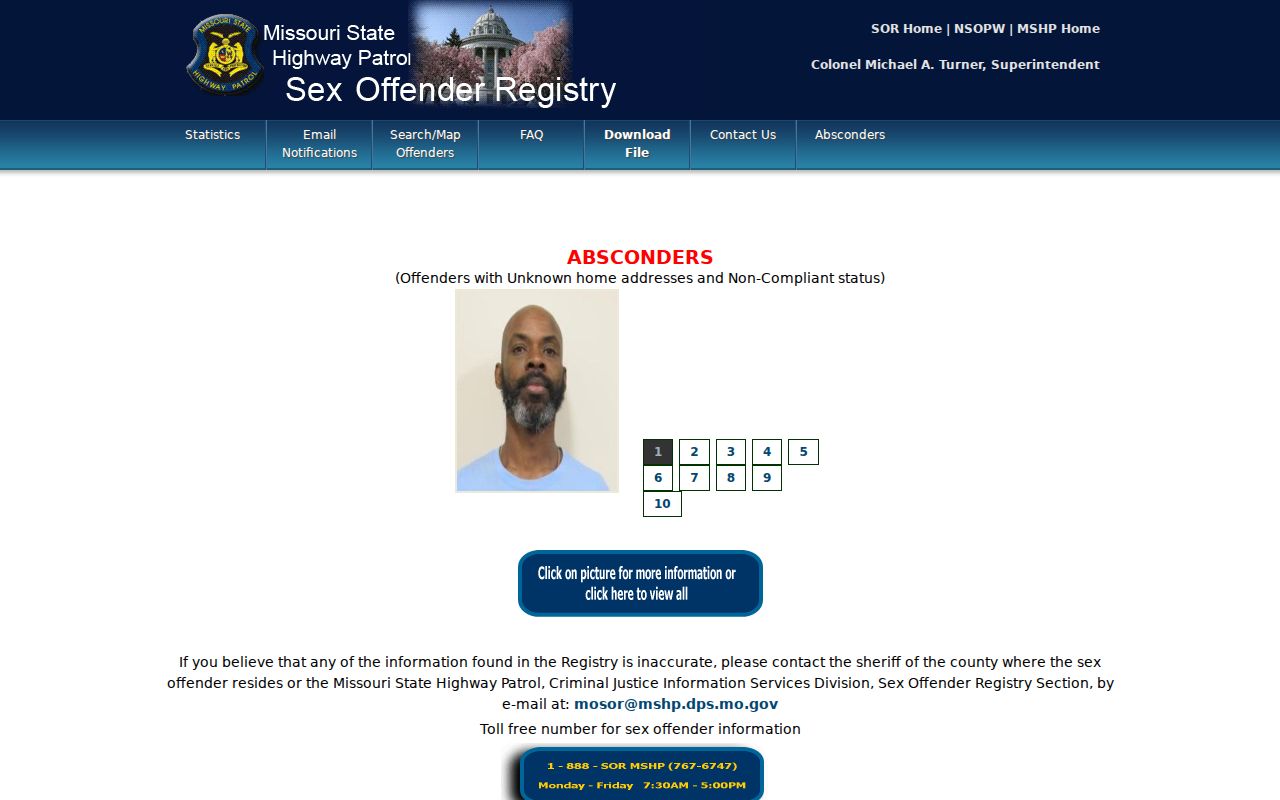
Its verified modes are name, county, ZIP, and address radius. The Patrol says it updates daily but is not guaranteed accurate and directs users to verify with the local sheriff or chief law-enforcement official. The public-use notice forbids using its information to facilitate a crime.
Verify an Ozark Resident Lookup
Use at least two independent record types and one date or identifier before describing someone as connected to Ozark. A parcel record and deed can support a recorded ownership connection. A voter match and a court case can corroborate separate record events. Neither pairing proves a present household. The following order keeps the source purpose clear and leaves the custodian in control of restricted records.
- Normalize the person’s name, then search the Assessor or GIS when a parcel is part of the question. Record the owner name, situs, mailing clue, parcel ID, and legal description without treating the mailing address as occupancy proof.
- Use the Missouri voter portal only for a precise registration confirmation. It asks for the exact registered first and last name, date of birth, last four Social Security digits, and county. Do not place those details in a shared link or report.
- Run the Case.net search concepts for party name, case number, and filing date. Compare county, role, type, and date, then preserve the case number rather than relying on a name alone.
- Call the correct Christian County clerk division or use the public terminal to ask whether the public file is available, archived, ordinary-copy, or certified-copy material. Current local copy and certification fees were not located, so confirm them before payment.
- For a record that needs legal proof, request it from the stated custodian and retain the record identifier, request date, and response. A clerk should not be asked to disclose a protected address.
- Docket
- A court’s schedule or running record of events in a case. A docket entry can point to a file without proving a person’s identity.
- Index
- A finding aid that helps locate a record. An index entry is not the same thing as the underlying file or scanned document image.
- Certified copy
- A copy issued and certified by the custodian for an official purpose. It differs from a search result or ordinary informational copy.
Vital Rules for Ozark Resident Lookup
Missouri vital records are not an open name directory. The Bureau of Vital Records ordering route covers birth, death, marriage, and divorce records with record-specific eligibility. Current state guidance lists births from 1920 to the present and deaths from 1980 to the present through state or local-agency channels. Death records more than 50 years old may be disclosed under RSMo 193.245. Birth copies remain subject to the direct-and-tangible-interest rule in RSMo 193.255 and related regulations.
For Ozark events, begin with the state and ask an authorized local issuing agency whether it can issue the needed record type and year. Marriage statements from the state identify spouses, date, and county, while the marriage certificate is obtained from the county Recorder. A divorce statement has names, date, and county; the decree or file belongs with the Circuit Clerk. State fees found in the research are $15 for a first birth, marriage, or divorce copy, $14 for a first death copy, and a five-year search window per search fee. Court copy fees were not located.
Note: A family event can support a historical relationship, but a certified record is available only through the eligibility and identification rules set by its custodian.
Ozark Resident Lookup for Family Links
For eligible families, Missouri provides a confidential route that is more appropriate than trying to infer a birth-parent connection from general records. The Missouri Adoption Information Registry allows eligible adult adoptees, biological parents, and adult siblings to register consent-based information. The research identifies forms CD-51A and CD-51B for adult adoptees and biological parents, and describes matching and consent timelines of roughly three months. The program is not a public list of names or addresses.
The official registry image illustrates the purpose-built state path for this kind of Ozark family-history question.
Use the state’s current forms and eligibility instructions, then allow the registry to manage confidential matching. For an heir question, the separate official sequence is probate index and case number, then a will, inventory, settlement, and Recorder deed trail. An obituary may connect relatives in a historical record, but it should not be used to infer a living person’s current address.
Ozark License and Entity Checks
A regulated credential or a legal entity can distinguish two people with the same name, but neither is a residence record. The Missouri Division of Professional Registration provides Licensee Search, renewal services, and downloadable listings. It covers regulated fields such as appraisers, architects, health professions, engineers, cosmetology, funeral directors, and others. The research did not safely capture the exact current search controls, disciplinary-result layout, or update schedule, so use the live state search rather than a copied list.
The official Missouri professional-registration screen is one source for an Ozark resident lookup when the question is a credential, not a home address.
Missouri Business Services can also be searched by business name, including a Starting With option and an Active Corporations filter. Public entity profiles can lead to a filing address, officer or manager information where filed, and copies or certificates. Treat a registered agent or business address as a filing connection, not evidence that the person lives in Ozark.
Legal Boundaries for an Ozark Resident Lookup
Missouri’s record rules are specific to the source. The Sunshine Law, RSMo 610.023, gives a custodian a three-business-day response rule and RSMo 610.026 addresses copy and research fees, but a request does not override a separate confidentiality rule. Voter records have statutory exceptions under RSMo 115.157. Court files exclude confidential, sealed, juvenile, and protected material. Vital and adoption records follow their own restrictions, and driver-license personal information is not a general public lookup under the federal Driver’s Privacy Protection Act.
Missouri Safe at Home provides qualifying participants a substitute address, mail forwarding, and special voter handling. It does not erase older records created before enrollment. Do not treat a missing search result as proof a person does not live in Ozark, and do not repeat protected information from a scanned record. When an online path ends, a focused Sunshine request should name the custodian, record type, parcel ID or case number, date range, desired format, and fee ceiling.
Lawful use. Use an Ozark resident lookup for lawful personal research, family history, reconnecting, heir matters, civic questions, or verifying a record with its custodian. Do not use records to stalk, harass, intimidate, or expose a protected person.